
🏭 How a Rockwell PLC Works
-
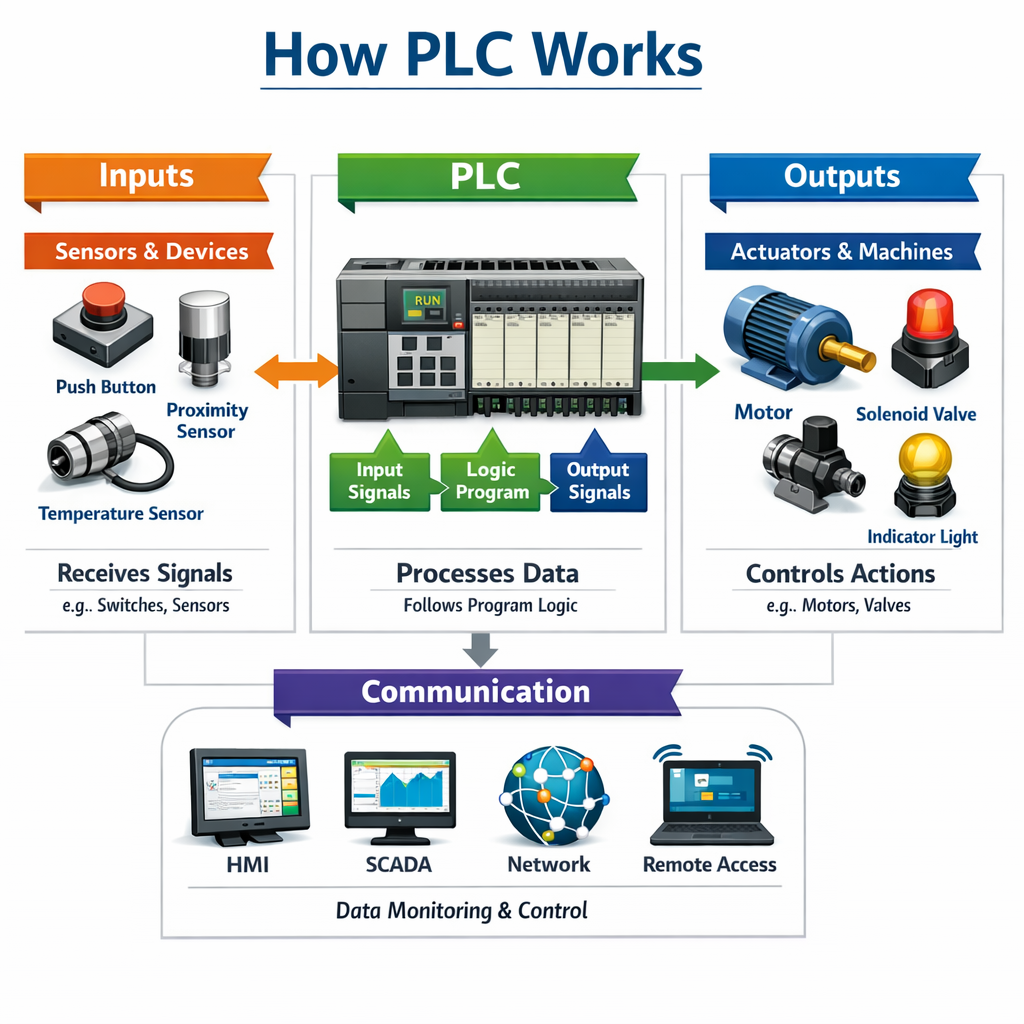
Rockwell Automation PLCs—especially the Allen‑Bradley ControlLogix, CompactLogix, and Micro800 families—are the backbone of modern industrial automation. They control everything from packaging lines to oil refineries, and they do it with precision, reliability, and real‑time decision‑making. But what actually happens inside a Rockwell PLC? How does it process logic, communicate with devices, and keep a plant running safely?
⚙️ What a PLC Really Is?
A Programmable Logic Controller (PLC) is an industrial computer designed to:
- Read Inputs.
- Execute Logic.
- Control Outputs.
- Communicate with other devices.
- Maintain real-time operation.
Although models vary, Rockwell PLCs generally include:
- CPU / Processor module
- Scans inputs
- Executes the user program
- Updates outputs
- Manages communications
- Handles diagnostics and faults
- Input Modules (read real input signals).
- Digital (on/off)
- Analog (0–20 mA, 0–10 V)
- Specialty (thermocouples, RTDs, encoders)
- Output modules (send commands to field devices).
- Motors
- Valves
- Solenoids
- Relays
- VFDs
- Communication modules
- EtherNet/IP
- ControlNet
- DeviceNet
- Serial
- Modbus
🧩Studio 5000 uses Tags instead of addresses.
Unlike older PLCs that use fixed memory addresses (e.g., B3:0/1), Rockwell’s Studio 5000 platform uses tag‑based programming.
- Human-readable names (e.g, Pump1_Start_cmd)
- User Defined Data Tags (UDT)
- Arrays for batch or multi device control.
- Easier troubleshooting.
- Cleaner, scalable programs
🧠 Program Execution and Task
Rockwell PLC organizes logic into:
- Tasks – Each tasks can contain multiple programs.
- Continuous Task – runs nonstop
- Periodic Task – runs at fixed intervals (e.g., every 10 ms)
- Event Task – triggered by an input or system event
- Routines – Each program contains routines written in:
- Ladder Logic (LD)
- Structured Text (ST)
- Function Block (FBD)
- Sequential Function Chart (SFC)
🛡️ Safety and Redundancy
Rockwell offers GuardLogix processors for safety‑rated applications.
Features include:
- Dual‑processor architecture
- SIL2/SIL3 compliance
- Safety‑rated instructions
- Integrated safety and standard logic in one environment
For critical systems, ControlLogix also supports:
- Redundant CPUs
- Redundant power supplies
- Redundant communication modules
🛠️ Diagnostics and Troubleshooting
Rockwell PLCs provide rich diagnostic tools:
- Module status LED’s
- Fault logs
- Controller tags for system health
- Studio 5000 online monitoring
- Trend charts
- Cross‑reference tools
This makes troubleshooting significantly easier compared to older PLC platforms.
 plc-automation.net