
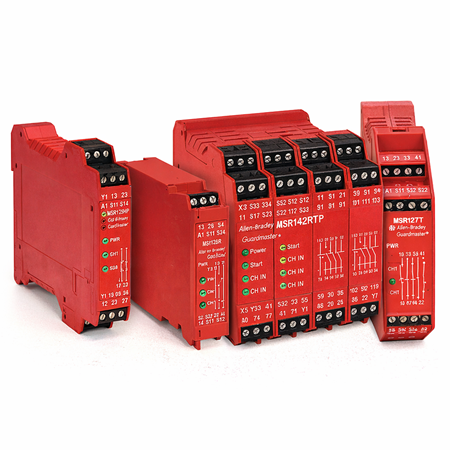
Single‑function safety relays from Rockwell Automation, (Allen‑Bradley Guardmaster 440R / MSR series) provide a simple, standards‑oriented way to implement safety functions such as emergency stop, guard monitoring, and light‑curtain integration without programmable controllers, simple installation, and low total cost of ownership.
They are offered in electromechanical and solid‑state output variants, with options for 24 VDC or 115/230 VAC coils.
They are compact, field-proven devices for small zone machine safety.
They offer multiple option for reset mode:
automatic/manual/monitored
Key reasons they’re a good choice
- Standards compliance and certification. Rockwell Guardmaster relays are designed to meet functional safety standards such as ISO 13849‑1 and IEC 62061, simplifying safety validation and risk assessments.
- Cost‑effective for single‑zone or small systems. Single‑function relays are the most economical option when you need a dedicated logic device for one safety function (e.g., E‑stop, guard door). They avoid the expense and complexity of a full safety controller.
- Simplicity and fast commissioning. Fixed functions, rotary switches for function selection, and universal inputs reduce setup time and wiring errors.
- Options for high cycle or harsh environments. Available in electromechanical and solid‑state versions so you can choose relays optimized for high cycle rates or long life.
- Reduced spare‑parts complexity. A compact family of relays covers most common safety functions, which reduces inventory and simplifies maintenance.
- Faster troubleshooting because functions are fixed and clearly labeled.
- Lower training burden for technicians compared with programmable controllers.
- Flexible mounting and terminal options (fixed, removable, spring‑clamp) to match panel practices.
Rockwell’s (Allen‑Bradley) single‑function safety relays are a reliable, standards‑aligned choice for single-small‑zone machine protection; match input type, reset behavior, and output form to your machine’s safety requirements, and escalate to modular or programmable safety systems when complexity grows.


.
 plc-automation.net